

How To Clear C-spine In The Field

I gave a talk the other 24-hour interval on clearing C-Spines, with Prezi linked here. As a disclaimer, this is my arroyo based on my clinical experience and from reading the literature – you should hash out this amongst your colleagues and review the literature to see if you reach the same conclusions. I would appreciate some comments – peer review if you will.
Objectives of the Talk:
- Utilize the Canadian C-Spine Rule and NEXUS criteria to aid in the use of clearing C-spines in Adults
- Gain an approach to immigration C-Spines in Pediatric Patients
- Sympathise when further imaging with CT and MRI may be indicated
Introduction:
- Canadian ER physicians meet 200, 000 alert, stable trauma victims per yr
- Of these, one% will terminate up having a clinically important C-Spine injury [CSI]
- If you consider just patients going for neck X-Rays, 2.v% will have a CSI [from NEXUS]
- A large variation in clearing c-spine practice continues to exist
- Although there is literature to guide our approach – much of information technology is confusing and contradictory
- Persistent medico-legal fear continues to influence our practice.
- 2 validated rules exist that can assist identify the need for radiography and clear C-Spines safely.
Clinical decision rules [CDRs]:
CDRs usually include a mix of history, physical findings and tests.
Advantages of using CDRs
- CDRs are useful where diagnostic dubiety.
- CDRs allow physicians to provide a standardized approach to problems.
- CDRs allow physicians to brand efficient and bias-free clinical decisions
Challenges with CDRs
- Applicability to the patient you are seeing [eastward.g. CCR – excluded pediatric patients]
- Designed by academics and applied by mostly non-academics
- Fail if medico cannot recollect nuances of inclusion/exclusions
- Publish best instance sensitivity [demand to look at the confidence intervals]
PEARL : Y'all practice non take to memorize CDR's – know where to look. I sometimes prove/discuss them with patients so that they understand my thinking procedure. In the following cases we will employ the ii major CDRs to guide our decision making.
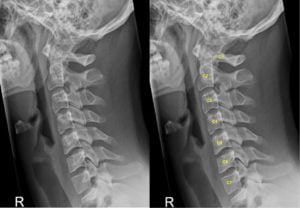
Example one:
65 year-old F driver rear-end collision on highway at 100 kmh
- Did NOT lose consciousness.
- Was wearing her seat-chugalug & the airbags deployed.
- Walks into the ER.
- Is lament of left wrist, left talocrural joint and chest wall tenderness.
On test:
- Alert, oriented. No complaints of neck pain or neurologic deficits.
- Moving her cervix to show you lot that she is okay.
- Mild seat-belt abrasion to chest.
- Abrasion to her wrist and ankle.
What would your approach be? What nigh the adjacent instance?
Example ii:
12 year-old passenger seated in the back seat of a vehicle that was hit by another car while changing lanes. The car was spun around and so hit a calorie-free pole. The patient did non lose consciousness. He was wearing his seat belt.
- The patient has been brought to the ER in a C-Spine neckband.
- He is lament of mild headache from a bruise to his right temple.
On Examination:
- Alert oriented.
- In a C-spine Collar.
- No complaints of neck pain or neurologic deficits.
- Small bruise to Correct temple.
NEXUS Dominion 1
Prospective observational study in 34000 patients in 21 centres in U.s.
- Results:
- 818 patients had C-Spine fractures on x-ray
- Rule missed 8/818. BUT only two/818 were clinically meaning
- Sensitivity = 99.half-dozen% (98.six‐100%,95%CI)
- Commentary:
- Largest study that we have.
- Subsequent validation by Steill et al 93% sensitive
- Useful in children [see below]
- Useful in those that fail CCR by criteria [age and mechanism]
Bottom Line
Patients have almost ZERO risk of CSI if they have:
- NO Mid-line tenderness
- NO Altered mentation
- NO intoxication [alcohol or drugs]
- NO neurologic deficits
- NO distracting injury
- Long bone fracture
- Large: crush/degloving/burn/laceration
- ER docs opinion
For more than information on distracting injuries
- Most recently Rose et al 2012 2 showed that only i/464 [0.ii%] of patients with no neck pain and a distracting injury had a c-spine injury on CT browse
- Some other written report 3 shows that 95% of CSI patients with distracting injuries Will Yet Accept Cervix PAIN despite the "distracting injury"
- Good Summary can be found at: ALIEM weblog
Spine Injuries in children
- Children < three years of age will not comply with 3-view radiographs
- Fortunately injuries below C1-C3 level are well-nigh non-existent [until 6 years of age]
- AP and Lateral radiographs + "clinical cess" is the standard of intendance
- High Gamble: BIG mechanism, multiply injured, head injury.
Applying CDR in Children
- NEXUS and kids iv
- 3,065 patients nether eighteen
- 88 nether ii years
- 817 aged 2-viii years [Big cohort compared to Paeds Studies]
- 2,160 aged 8-17 yrs [Big Accomplice]
- 3,065 patients nether eighteen
- xxx kids had CSI
- Almost all were in older kids [aged 11-17]
- ZERO CHILDREN WERE MISSED Past APPLYING NEXUS RULE
- But 5/3065 kids with fractures were 9 and under
- only ii kids <3 had CSI [blazon iii odontoid in a 2yo and Occipital fracture in a 3yo]
- the 3 kids 6-ix yo had pregnant fractures that I remember would not accept been missed [cranio-cervical dissociation, C1 pismire/post curvation fracture + type ii odontoid, C4 flexion teardrop fracture]
- As of my lit review – one case report of NEXUS miss, a 3yo who had a lap-belt sign [visceral (and therefore distracting) injury]
- Although the authors exercise not recommend NEXUS awarding in the <8yo cohort, I feel that the number of kids 5-8 together with the reliability of a child >5yo means that it may be applicable.
- My practice. I utilise it in the reliable > 5yo. I have depression threshold for "distracting injury". I consider High run a risk as: high risk mechanism & child has other injuries.
- For kids that I cannot use the rule [eastward.g. toddlers and infants]:
- ALL go immobilised with sandbags/tape/neckband
- ALL get bedside AP and Lateral Xray
- If xrays await fine: COLLAR OFF
- If child moves neck: CLEAR
- If child has guarding/torticollis: CT Neck
CASE iii:
40 yo Male person who [drunkard] vicious downwards a flying of stairs.
- He was knocked out briefly.
- He is not lament of whatsoever C –Spine tenderness.
On Exam:
- Alert oriented [just drunk].
- In a C-spine Neckband.
- No complaints of neck pain or neurologic deficits.
- Small trample to Right temple.
This patient fails NEXUS due to intoxication. What practise you lot do with this guy?
The Canadian C Spine Rule [CCR] 5 :
- Prospective written report 8900 patients in 10 Canadian centres
- Included:
- GCS 15 and normal VS
- neck pain from injury or
- no neck pain and trauma above clavicles, worrisome mechanism for C spine, not ambulatory
- Included:
- Excluded < 16yo, presenting >48h, pregnant, unstable, GCS <15, known spine dis [east.g. RA], trivial injury [laceration]
- Defined CSI : whatever #, dislocation or ligamentous instability
- Secondary outcome: clinically unimportant injury
- 2700 patients did non go X-rays [14 mean solar day follow upwardly telephone call]
- Results:
- Sensitivity = 100% [98‐100]
- Specificity = 42% [40-44]
How to Apply the Rule: Y'all have to ask yourself 3 questions?
i) Is there a high hazard feature that mandates radiography? … if NOT …
2) Is there ANY low risk feature that will permit safe range-of-motion testing? If aye …
3) Can the patient move 45 deg left and right? If yes – Clear!
Here'southward a visual representation of the CCR:

Mutual Problems with the CCR
What to exercise with midline tenderness?
What some of the literature shows:
- No midline tenderness confers NPV of 98%
- CCR applied as is shows that presence of ANY low chance feature allows for condom ROM
- CCR did not exclude drunks. Simply requisite is GCS 15.
- [Duane et al J Trauma 2011 6 ] [Sicker patients 6.iv% incidence of CSI]
- Midline tender + sober + no distracting injury = 12% will have injury on CT scan
- Midline tender + either intoxicated or with distracting injury = viii.4% injury on CT scan
- NO comment on whether these injuries are clinically pregnant or not.
The lesser line:
Midline tenderness does not trump whatsoever of the other "Low Risk Features" that permit rubber range-of-motion testing. Ifpersistent andsignificant this suggest plenty take a chance to X-ray (and maybe CT depending on patient).
What to do with drunk patients?
- Adventure for C-Spine injury + GCS < 15 = Evidently Radiographs.
- Look for them to have GCS 15 and try and clear clinically.
- If they tin't comply with manifestly films go straight to CT.
Perception that CT is better for ALL?
- CT Is NOT Better for ALL
I accept heard from a couple of colleagues that "apparently films miss 20-xxx% of C-Spine injuries". I even attended a contempo conference where a speaker [who I respect] suggested a "CT for all" approach for those we cannot articulate with NEXUS and CCR because:
- It appears that there's an epidemic of inadequate 10-Rays of the C spine
- It appears that ER docs of a sudden seem to suck at reading one of their bread and butter tests.
I took a expect the "CT is ameliorate literature" and I do not agree:
- The incidence of CSI in these studies is 5-23%. [Compare that to 2.4% for NEXUS]
- They seem to include the sicker crowd that would not typically be able to exist cleared clinically [unconscious, altered]
- They compare inadequate C-Spine Films to adequate CT scans!
- They have methodologic flaws or are making these recommendations based on weak evidence
The bottom line:
[one] Warning stable patients at chance of C-Spine injury with an incidence of about 2.5%–> Plainly FILMS ARE JUST FINE HERE [2] Sicker patients with an incidence of greater than v% [head injured, contradistinct, polytrauma etc]
–> THESE PATIENTS MAY NEED CT
When CT may be necessary:
Reasonable indications for CT from my feel:
- Suspicious looking X-Ray/inadequate 10-Ray
- Persistent significant midline tenderness
- Polytrauma cases going for CT head since co-incidence of caput/cervix injuries v%
- Intubated patients / patients unable to comply with three views + swimmers' view
- Patients with existing C spine illness / elderly patients at risk for fake positive Ten-Ray
When MRI may exist necessary:
CT solitary has been shown to be a reliable way to exclude unstable injuries; even so studies similar this from the CJEM vii are contradictory and incite fearfulness in clinicians. Some of the challenges ascend because:
- Evidence suggests that ii% of patients with negative CT may have a neurosurgical lesion on an MRI
- Surgeons do non have uniform practice in these patients
- Frequently CT is negative just y'all have a symptomatic patient
- Despite the utility of the Flex-Ex View in the CJEM article above, neck pain/symptoms despite Normal CT has a differential diagnosis – the most of import of whichmay or may non be picked upward on Flex-Ex!
Bottom line – MRI indicated for:
Negative CT and persistent significant pain/guarding or Neurologic arrears.
I would welcome your thoughts.
This post was originally published on the ERMentor Weblog. It was revised by Riley Golby and Rob Carey and reposted on CanadiEM on 20 Twenty XXXX.
References
one.
Hoffman JR, Mower WR, Wolfson AB, Todd KH, Zucker MI. Validity of a Set of Clinical Criteria to Dominion Out Injury to the Cervical Spine in Patients with Blunt Trauma. New England Journal of Medicine. 2000;343(2):94-99. doi:ten.1056/nejm200007133430203.
ii.
Rose 1000, Rosal Fifty, Gonzalez R, et al. Clinical clearance of the cervical spine in patients with distracting injuries: It is fourth dimension to dispel the myth. J Trauma Astute Care Surg. 2012;73(2):498-502.
3.
Konstantinidis A, Plurad D, Barmparas G, et al. The presence of nonthoracic distracting injuries does not affect the initial clinical examination of the cervical spine in evaluable blunt trauma patients: a prospective observational study. J Trauma. 2011;71(3):528-532.
iv.
Viccellio P, Simon H, Pressman B, et al. A prospective multicenter written report of cervical spine injury in children. Pediatrics. 2001;108(2):E20.
v.
Stiell I, Wells G, Vandemheen K, et al. The Canadian C-spine rule for radiography in alarm and stable trauma patients. JAMA. 2001;286(15):1841-1848.
6.
Duane T, Mayglothling J, Wilson Due south, et al. National Emergency X-Radiography Utilization Written report criteria is inadequate to rule out fracture after significant blunt trauma compared with computed tomography. J Trauma. 2011;70(4):829-831.
seven.
Grunau B, Dibski D, Hall J. The daunting task of "clearing" the cervical spine. CJEM. 2012;14(3):187-192.
(Visited 16,116 times, 1 visits today)
- Bio
- Latest Posts

Nadim is an emergency physician at the S Health Campus in Calgary, Alberta. He is passionate about online learning and recently fabricated a transition into man performance coaching. He is currently working on introducing the coaching model into medical education.
Source: https://canadiem.org/clearing-the-c-spine/
0 Response to "How To Clear C-spine In The Field"
Post a Comment